
Inside the Process, Materials, and Installation Tips
At Jeep Recyclers, we’re constantly chasing one thing: better. Better quality, better processes, and a better experience for our customers. That philosophy is exactly what drove the evolution of our Full Size Jeep woodgrain trim kits.
In this article, we want to pull back the curtain and show you:
- How our trim is made
- Why we chose the materials we use
- What makes it different from other options on the market
- And how to get the best results during installation
Perfection Is an Evolution
Perfection isn’t a single moment — it’s a process. It’s how a product is designed, produced, packaged, shipped, and ultimately installed on your vehicle.
When we first set out to improve our woodgrain trim production, we partnered with a tooling company to develop automated cutting solutions. After months of meetings and over-engineering, it became clear that the process wasn’t moving fast enough — or precisely enough.
So we pivoted.
We returned to hand-cutting, just like the original craftsmen did years ago, and built our own systems from the ground up. That decision allowed us to refine every detail while we developed better tooling in parallel.
The Evolution of Our Cutting Process
- Phase 1 – Fully Hand-Cut:
One closed trim kit took roughly a week and a half to complete. - Phase 2 – Custom Dies & Arbor Press:
With our second system, we can now produce two complete kits per day, with far greater consistency and accuracy. - Phase 3 – Advanced System (Coming Soon):
The next phase will allow us to produce four to five kits per day, while maintaining the same quality standards.
Each step forward means faster turnaround times without compromising fit or finish.
Precision Tooling Makes the Difference
We’ve developed a wide range of custom dies to ensure accuracy and repeatability — including an adjustable keyhole die that works for:
- 1979 models with centered keyholes
- Later models with offset keyholes
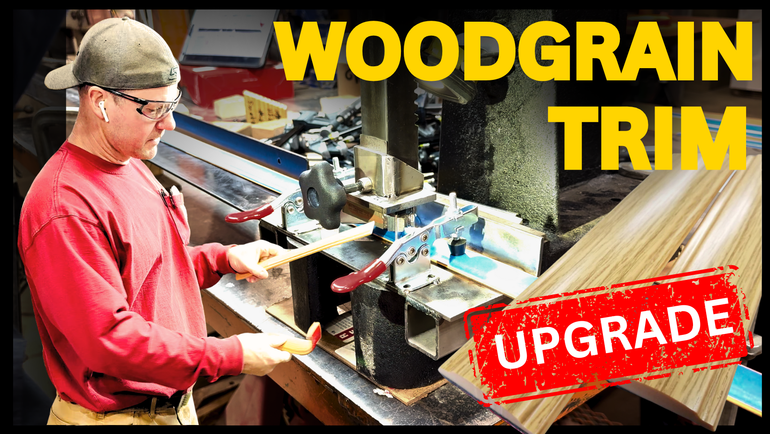
Using an old-school arbor press, we’re able to straighten, align, cut, and prep each piece with precision before it’s labeled, protected, and packaged.
Comparing Our Trim to Other Options on the Market
There are other trim products available — including newer reproductions — but after testing and comparison, we deliberately chose to continue offering the original-style trim.
Here’s why:
Strength & Appearance
- Our trim is significantly more rigid yet with a little heat it still has the ability to be extremely flexible for the perfect install
- It has a cleaner profile and more authentic appearance (no woodgrain plugs needed!)
- Competing versions feel noticeably thinner and flimsier by comparison
Simply put, the original trim looks right on a Full Size Jeep — and it holds up.
Updated Adhesion: A Major Improvement
One of the biggest upgrades we’ve made is on the backside of the trim.
Our current kits now use 3M VHB (Very High Bond) adhesive, designed for long-term exterior use. This is a major improvement over standard double-sided tape, which often required supplemental glue and could fail over time.
If you’ve had trim issues in the past, this change alone makes a dramatic difference.
Trusted by the Best
The same trim we offer is used on some of the most well-known Grand Wagoneers in the world — including builds from Jeep Heritage. When the best builders choose it, that tells you everything you need to know.
Straightening & Handling the Trim
Every piece is straightened before it leaves our shop. However, shipping can occasionally cause slight shape changes.
The fix is simple:
- Apply gentle heat with a quality heat gun
- The trim becomes pliable and straightens easily
- Once cooled, it retains its shape
Despite being rigid when cool, the material softens smoothly with heat and is extremely resistant to damage.
Installation Tip: Closing Seams with Super Glue
Some customers rely solely on the VHB adhesive — and that’s perfectly fine. However, for the tightest seams possible, we personally recommend pre-gluing closed joints before installation.
Our preferred method:
- Use a controllable super glue (Loctite style applicator)
- Apply a generous bead inside the joint
- Heat the trim slightly to make it malleable
- Press together and hold for ~45 seconds per section
- Allow 12–24 hours to fully cure
Any excess glue can be cleanly removed later with a plastic razor blade — no scarring, no damage.
Labeling, Protection, and Packaging
Each piece is:
- Clearly labeled (no guessing during install)
- Protected with painter’s tape
- Packaged carefully to minimize handling damage
- We want installation to be straightforward, even for first-timers.
Built with Gratitude
We know many of you waited patiently while we refined this process — and we truly appreciate it. The result is a product that looks right, fits properly, and will stay on your Full Size Jeep for years to come.
Thank you for trusting us, supporting our work, and helping us keep these vehicles on the road.